


Affordable Hair Transplant & Hair Restoration In Lakewood, Ohio
Click on Image
Below to see Video
Misc Videos

Patient Recommendations
Misc Videos
Thank you Dr. Bolton
Different Forms of Alopecia: The Causes of Hair Loss
There are many types of hair loss. The most common cause is genetic hair loss inherited from a a male or female relative on either side of the family. Other causes include disease, stress, trauma, diet or hormones. Whatever the reason, hair loss can effect a person's overall self esteem so it's important to identify the cause and treat it accordingly. If you would like to come in for a free consultation, the doctor would be more than happy to diagnose your condition.
 Androgenetic Alopecia (pattern baldness)
80 million men and women suffer from genetic hair loss which is called androgenetic alopecia. Androgenetic alopecia is hereditary baldness passed down from male or female relatives with balding or thinning hair. Male pattern baldness can be prevented in the vertex and crown with a DHT blocker. DHT blocker does not work in the frontal hair line and is not for women or children. The most effective permanent solution for androgenetic alopecia is hair transplantation.
Alopecia Areata (auto immune disorders)
Some diseases cause hair to fall out when white blood cells attack hair follicles. Some autoimmune disorders that cause alopecia areata include thyroid disease, lupus, vitiligo, ulcerative colitis and rheumatoid arthritis. With alopecia areata hair can fall out and re-grow again and again.
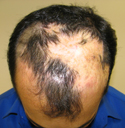 Cicatricial Alopecia (scarring)
-
Cicatricial alopecia is a rare form of hair loss. In hair loss caused by cicatricial alopecia,
inflammation and scarring destroy the delicate hair follicles. Scars can occur from burns or
injuries
and it may also be caused from skin disorders such as lichen planus, fungal infections or lupus
erythematosus.
Diffuse Pattern Alopecia (DPA)
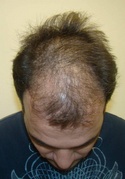
When the frontal hairline remains in tact but hair becomes thin in an even pattern everywhere except the safe zone which is the DHT resistant area on the sides and back of the head then diffuse pattern alopecia is present.
Diffuse Unpatterned Allopecia (DUPA)
When hair loss is evenly thin throughout the entire head, even in the safe zone, this is called diffuse unpatterned alopecia. Those with diffuse unpatterned allopecia do not have good donor hair and should not receive a hair transplant. To be sure of your situation, it is advisable to make a complimentary appointment to see Dr. Bolton for an accurate diagnosis.
Dihydrotestosterone (DHT)
A hormone called dihydrotestosterone or DHT is the cause of pattern baldness in both men and women. DHT is an androgen, a hormone responsible for the development of sexual characteristics. This hormone is produced more rapidly as a person ages and is created when testosterone and an enzyme called Type II 5-alpha Reductase are synthesized. For those who are genetically predispositioned to be affected by DHT, hair miniaturization can occur because of mucus buildup in the hair follicles.
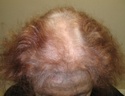 Female Pattern Hair loss (androgenetic alopecia)
-
In female pattern baldness the frontal hairline often stays in
tact
while thinning or diffusing occurs throughout the rest of the head. Female pattern baldness is
genetically inherited for those susceptible to DHT.
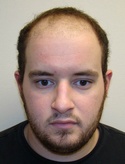 Male Pattern Baldness (androgenetic alopecia)
Male pattern baldness is the number one cause of hair loss in the United States. Passed down through genetics, male pattern baldness can be inherited through both the mother and the father. Typical male pattern baldness begins with a receding hairline or thinning crown that continues to thin over time until hair is very thin or completely gone everywhere except the safe zone. The safe zone is the horseshoe area on the sides and back of the head where hair follicles are resistant to DHT, a hormone that causes hair loss.
Phases of Hair Growth
anagen phase (growth phase)
A new hair grows from a hair follicle beneath the surface of the skin. The average hair will grow 1/2 inch (1cm) per month from 2 to 8 years.
catagen phase (transitional phase)
After the anagen phase the hair stops growing for a 2-4 week transition when the hair detaches from the blood supply. Only 2-3% of your hair is in this state at the same time.
telogen phase (resting phase)
10-15% of your hair enters a resting phase that lasts from 2 to 4 months. As many as 50 to 100 hairs per day will shed during this phase and new hairs will replace the hairs that fall out.
telogen effluvium (stress or shock)
Telogen effluvium is temporary hair loss due to stress or "shock" caused by physical or emotional conditions. Hair goes into a resting phase, growth is temporarily stopped, and hair falls out in clumps or patches. A wide range of causes can be attributed to telgen effluvium such as unusual weight loss, diet, disease, medicine side effects, emotional trauma, or nutritional deficiencies. If the causes are eliminated, hair usually starts to grow again within 6 to 9 months.
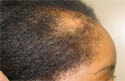
traction alopecia (scars from pulling hair too tightly)
When hair is pulled too tightly and the scalp becomes scarred, traction alopecia can occur. If the pulling is stopped soon enough the situation can be corrected otherwise scarring and hair loss may become permanent. Hair styles to be cautious about are pony and pig tails, braids and dreadlocks.
trichotillomania (hair pulling disorder)
Hair pulling disorder is a mental illness where people compulsively pull out their own hair and often hide the behavior with hats or wigs.



 Josh
Josh Aldo
Aldo Adrien
 Patient p81
 Rahim
Rahim Ryan
Ryan-
 Apr 12, 2024
Brenda
Florida

In 2006, Dr. Bolton did my hair transplant here in Nashville. I was 56 years old at the time. He did a great job. I was losing tons of hair on top, in the front. The staff was great and followed up with me for several days. I didnt have any problems at all with the transplant. Im now 73 years old and my hair looks great. I highly recommend Dr.... -
Apr 12, 2024
Daniel
Florida
I couldn't be happier with the results. If you are sitting on the fence trying to decide if you should do this... Let me answer to question for you. YES! You will not regret the decision. Dr. Bolton is the best. -
Apr 12, 2024
O.J.
Florida
Im an Afro-Caribbean Man (Jamaican) That Got Burned When I was 2 Years Old On My Head and Never Had a Full Head of Hair. I Reached out to Dr. Bolton After Being Recommended by a NYC Doctor He Changed My Life Giving Me a Hairline and Enough Hair to Style with Consealer and Stop Wearing Hats. Changed My Mood and Outlook on the World. He Took My... -
Apr 12, 2024
Jose
Florida
This user only left a rating -
Apr 9, 2024
Tony
Florida
Was a great experience from beginning to end. These guys do excellent work and I was so happy with the difference in my hair. All my friends ask what Ive done to look so much younger. My wife loves the new younger look. Five. Stars all the way. -
Apr 5, 2024
David
Florida
Definitely very pleased with my hair transplant results, even all these years later. Only wish I had done it sooner! -
Apr 4, 2024
Dave
Florida
The Doctor is the most knowledgeable and simply amazing. The staff is marvelous. Loved their caring and prompt services. 7 stars! -
Apr 4, 2024
Roman
Florida
Very highly recommended to anyone that wants to have fantastic results -
Mar 30, 2024
Mark
Florida
Dr. Bolton's team is awesome. I've had two transplants and achieved density I didn't think was possible. Do yourself a favor and go with Dr Bolton's suggestion. Although he's very patient he knows what he's doing. On his first attempt the hairline was perfect. Don't rush it, allow a few days to relax and keep your new scalp moisturized. Friends and... -
Mar 29, 2024
Travis
Florida
Had Dr. Bolton do 3 separate transplants on me over about a 15 year period. I have had people tell me I look younger now than I did 29 years ago. I was completely bald on top back then and now have a full head of hair. Couldnt recommend him more highly. I even traveled from Tennessee to do my 3rd transplant after having the first 2 done in...


27 YEARS EXCLUSIVELY DEDICATED TO HAIR TRANSPLANTS WITH UNSURPASSED RESULTS
Excellent
Based on 775 Verified Patient Testimonials / Reviews from


- Patient References:
- TYPES OF HAIR LOSSES:
- Diffuse Hair
- Receding Hair Line
- Thinning Hair
- MISCELLANEOUS:
- Hair Transplant Blog / Updates
- Corrective Hair Surgery
- Glossary of Terms
- Hair Transplant Society
- Hair Plugs
- Hair Transplant
- Healing Time
- Microscopes
- News
- Balding Myths
- SOCIAL PROFILES:
-

THE PATIENT AND ANY OTHER PERSON RESPONSIBLE FOR PAYMENT HAS A RIGHT TO REFUSE TO PAY, CANCEL PAYMENT, OR BE REIMBURSED FOR PAYMENT FOR ANY OTHER SERVICE, EXAMINATION, OR TREATMENT THAT IS PERFORMED AS A RESULT OF AND WITHIN 72 HOURS OF RESPONDING TO THE ADVERTISEMENT FOR THE FREE, DISCOUNTED FEE, OR REDUCED FEE SERVICE, EXAMINATION, OR TREATMENT.
We are committed to protecting your privacy. The information you enter on our site is held in confidence between you and us. We do not sell, trade, or rent your personal information to others. This privacy statement discloses how the information you provide is used and protected.
© 2024 Great Hair Transplants, All Rights Reserved.